Re-Set Framework
Re-Set Framework is a structured way of thinking about and designing human settlements so that all their impacts are positive and integrated, rather than harmful and mitigated.
At its core, the framework asks: what would it look like if the needs of people, community and natural systems were all met simultaneously, not traded off against each other?
Five Interconnected Systems
A Regenerative Settlement works with five interconnected systems that mesh together to provide food, energy, homes, wellbeing, community, livelihoods and wild spaces – in ways that accelerate the transition to genuinely regenerative lives and a healthier future for humans and nature alike.
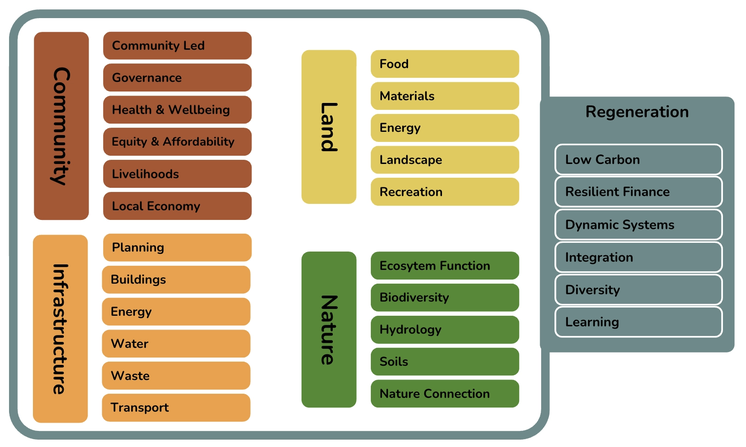
5 Systems
The first four systems relate to the tangible, practical dimensions of how a settlement is built and lived in. The fifth – Regeneration – is the binding principle that holds them all together.
Community:
The settlement is owned and / or managed communally by the people who live there. Democratic governance structures enable collective decision-making. The community takes responsibility for the health and wellbeing of all residents, supports local livelihoods and a vibrant local economy, and actively seeks connection with its wider locality and the natural world around it.
Thriving community is not an add-on – it is the foundation.
Infrastructure:
The physical machinery of the settlement. Homes are built to be super energy-efficient, ultra-low carbon, and designed so residents can maintain and repair them. Smart and circular systems reduce resource use and emissions. Buildings are arranged to maximise neighbourliness – with shared spaces, pathways and communal areas that reduce isolation and strengthen connection. Low-carbon transport, EV sharing and electric bikes are the norm rather than the exception.
Infrastructure that serves people and planet, not just convenience.
Land:
Connection to land opens up extraordinary possibilities. Local food production – grown on the doorstep using regenerative practices – is a priority for residents and the surrounding locality. Open space for rest, reflection and recreation. Forests replanted. Building materials potentially grown on site. Land is not a commodity to be consumed but a living system to be worked with.
With land comes possibility. With regenerative land management comes abundance.
Nature:
We are nature – even when we forget it. Regenerative settlements build in wildlife corridors, woodlands, hedgerows, meadows, wetlands and ecological niches, weaving human lives back into thriving ecosystems. Biodiversity, healthy soils and ecosystem function are not aspirational extras but foundational requirements. Where conventional development drives nature and people apart, Re-Set brings them back together.
Nature is not a backdrop. It is the system we are part of.
Regeneration:
The first four systems are tied together by the fifth.
Regeneration goes beyond minimising harm – it actively restores and enhances the health of the living systems we are part of and depend upon. It frames human settlements as part of interconnected socio-ecological systems that can evolve towards greater resilience, vitality and capacity to thrive.
Rather than simply sustaining existing conditions, regeneration focuses on net-positive impacts: enriching soils and ecosystems, strengthening communities, and cultivating cultures that can continually learn and adapt. It works with the unique character of each place, and with the co-evolution of human and natural systems over time.
Regeneration also captures the wider, systems-level challenges – from climate and finance to governance and economic resilience – that connect a settlement to the world beyond its boundaries. It is why, in the framework diagram, regeneration wraps around all four other systems.
This is an approach, not a blueprint. A direction of travel, not a destination.
Bringing it all together:
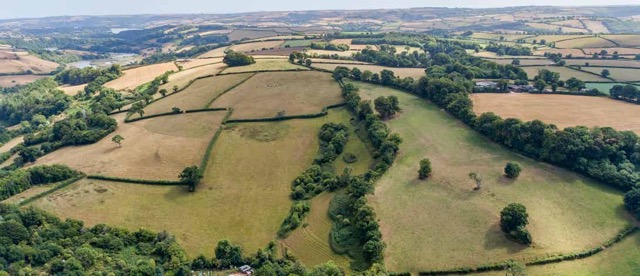
What makes Re-Set different is not any single one of these systems in isolation – it is the intention to pursue all five together, in one place, at the same time. Most development addresses some of these things, partially, often as an afterthought. Re-Set puts them all at the centre, from the start.
Most of what is needed already exists – in terms of thinking, technologies, models and practice.
The Handbook brings it together in one place, as a practical guide for people ready to make it real.
Stay in the loop
Sign up to our newsletter to hear about the latest news and developments.